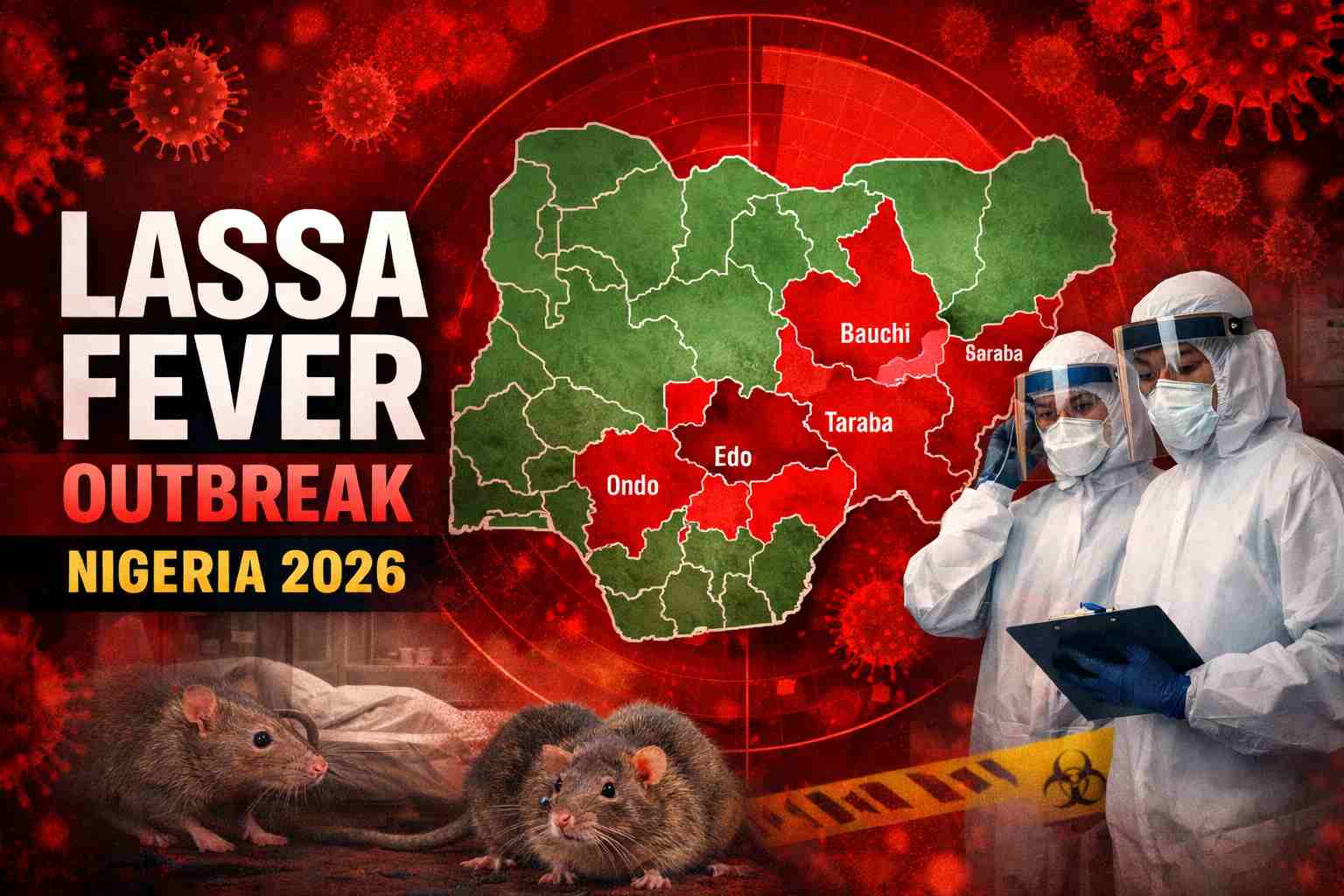
The Lassa fever outbreak in Nigeria 2026 has once again placed national and global health authorities on alert.
According to the latest situation report from the (NCDC), there has been a notable increase in confirmed cases during Epidemiological (Epi) Week 6 (February 2–8, 2026).
While Nigeria experiences seasonal Lassa fever outbreaks almost every year, the 2026 pattern presents unique epidemiological concerns — particularly the rising case fatality rate (CFR) and infections among healthcare workers.
This comprehensive guide provides:
- Verified case data from 2026
- State-by-state breakdown
- Comparison with 2025 outbreak trends
- Epidemiology and transmission dynamics
- Clinical features and treatment
- Government and international response
- Key public health challenges
- Practical prevention strategies for individuals and communities
Recall also: Summary of Sokoto State Government Dengue Fever Advisory November 2025
Latest Update: Week 6 Epidemiological Data (2026)
Confirmed Increase in Cases
In Epi Week 6:
- 74 confirmed cases were recorded
- Up from 44 confirmed cases in Week 5
- 271 suspected cases reported
- 15 deaths documented
- Case Fatality Rate (CFR): 20.3%
This week-on-week increase signals ongoing community transmission.
Cumulative Situation (Epi Week 1–6, 2026)
From January to early February 2026:
- 1,034 suspected cases
- 240 confirmed cases
- 4 probable cases
- 51 deaths among confirmed cases
- Overall CFR: 21.3%
For comparison:
During the same period in 2025:
- 1,913 suspected cases
- 413 confirmed cases
- 80 deaths
- CFR: 19.4%
Although overall case numbers are lower than in 2025, the higher fatality rate in 2026 is a major concern.
States Affected in 2026
In Week 6 alone, confirmed cases were reported in:
- Taraba
- Ondo
- Bauchi
- Edo
- Benue
- Nasarawa
- Kogi
- Ebonyi
High-Burden States (89% of confirmed cases)
- Bauchi – 38%
- Taraba – 22%
- Ondo – 20%
- Edo – 9%
The remaining 11% were distributed across six other states.
In total, 10 states and 42 Local Government Areas (LGAs) have recorded confirmed cases in 2026.
Who Is Most at Risk?
Age Distribution
- Most affected group: 21–30 years
- Median age: 29 years
- Age range: 1 to 74 years
Gender Distribution
- Male-to-female ratio: 1:0.7
- Slightly more males affected than females
Healthcare Workers
Two healthcare workers were infected during Week 6, raising concerns about:
- Gaps in infection prevention and control (IPC)
- PPE shortages or improper usage
- Delayed case recognition
Healthcare-associated transmission remains a significant risk during Lassa outbreaks.
What Is Lassa Fever?
Lassa fever is an acute viral haemorrhagic illness caused by the Lassa virus.
Causative Agent
The disease is caused by the Lassa virus, a single-stranded RNA virus belonging to the Arenaviridae family.
Reservoir Host
The primary host is the Mastomys rat, commonly found in West Africa.
These rodents:
- Live in and around human homes
- Reproduce rapidly
- Shed virus in urine and faeces
How Lassa Fever Spreads
1. Rodent-to-Human Transmission
Occurs through:
- Eating food contaminated by rat urine or droppings
- Inhaling contaminated particles
- Handling infected rodents
2. Human-to-Human Transmission
Possible through:
- Contact with blood
- Vomit
- Urine
- Saliva
- Semen
- Other bodily fluids
3. Healthcare-Associated Transmission
When:
- PPE is not used correctly
- Isolation protocols are not followed
- Contaminated medical equipment is reused
Symptoms of Lassa Fever
Lassa fever symptoms can vary from mild to severe.
Early Symptoms
- Fever
- General weakness
- Headache
- Muscle pain
- Sore throat
Progressive Symptoms
- Chest pain
- Vomiting
- Diarrhoea
- Facial swelling
- Bleeding from gums, nose or gastrointestinal tract
Severe Complications
- Organ failure
- Shock
- Seizures
- Respiratory distress
Approximately 80% of infections may be mild or asymptomatic, but severe cases can be fatal.
Why the 2026 Case Fatality Rate Is Concerning
The CFR of 21.3% is higher than 2025’s 19.4%.
Contributing factors include:
- Late hospital presentation
- Delayed diagnosis
- Poor health-seeking behaviour
- High cost of care
- Limited awareness
- Infections among healthcare workers
Early detection significantly improves survival.
Treatment of Lassa Fever
Ribavirin
The antiviral drug Ribavirin is most effective when administered early.
It can be given as:
- Intravenous injection
- Oral tablets
Treatment is most beneficial within the first 6 days of symptom onset.
Supportive Care
Includes:
- Fluid replacement
- Oxygen therapy
- Blood pressure stabilization
- Management of complications
There is currently no widely available licensed vaccine.
Government Response to the 2026 Outbreak
The has activated:
1. National Lassa Fever Incident Management System (IMS)
A coordinated multi-sectoral response mechanism.
2. Emergency Operations Centre (EOC)
Activated nationally and in high-burden states.
3. Deployment of Rapid Response Teams
Sent to seven high-risk states.
4. International Collaboration
Support from:
- Médecins Sans Frontières
- World Health Organization
- Centers for Disease Control and Prevention
5. Distribution of Response Commodities
- Ribavirin
- PPE
- Body bags
- Hypochlorite
- Sanitizers
- Thermometers
- Awareness materials
Laboratory networks have also been strengthened for rapid diagnosis.
Key Public Health Challenges in 2026
1. Late Presentation
Many patients arrive at hospitals when complications have already developed.
2. Low Awareness
Some communities still attribute symptoms to malaria or spiritual causes.
3. Environmental Sanitation
Poor waste management increases rodent infestation.
4. Healthcare Worker Infections
Indicates gaps in infection control compliance.
How to Stay Protected from Lassa Fever in Nigeria (Expert Recommendations)
1. Strengthen Household Rodent Control
- Seal holes in walls and floors
- Use rodent traps
- Keep surroundings clean
- Store food in airtight containers
2. Practice Safe Food Handling
- Wash food thoroughly
- Avoid drying food on open ground
- Cover water containers
3. Maintain Hand Hygiene
- Wash hands regularly with soap
- Use alcohol-based sanitizers
4. Avoid Contact with Rodents
- Do not consume rats
- Avoid sweeping dry rodent droppings (use disinfectant first)
5. Seek Medical Care Early
If you experience:
- Fever not responding to malaria treatment
- Weakness
- Bleeding
- Chest pain
Visit a designated treatment centre immediately.
Early Ribavirin administration can be life-saving.
Recommendations for Healthcare Workers
- Maintain high suspicion index
- Use PPE consistently
- Isolate suspected cases promptly
- Follow standard IPC guidelines
- Report cases immediately to authorities
Role of Communities in Containment
Community engagement is critical.
Local leaders should:
- Promote awareness campaigns
- Encourage environmental sanitation
- Discourage stigma
- Support early referral
Lassa fever is preventable when communities and health authorities collaborate.
Outlook for the Rest of 2026
Historically, Lassa fever peaks during the dry season (December–April).
Experts anticipate:
- Continued sporadic transmission
- Possible rise in high-burden states
- Increased surveillance efforts
Proactive measures may reduce overall mortality if early detection improves.
Frequently Asked Questions (FAQs)
Is Lassa fever contagious?
Yes, through bodily fluids and contaminated materials.
Can Lassa fever be cured?
Early treatment with Ribavirin improves survival significantly.
Is there a vaccine?
Currently, no widely available licensed vaccine exists.
Can it be mistaken for malaria?
Yes. Early symptoms resemble malaria, which often delays diagnosis.
Final Thoughts
The Lassa fever outbreak in Nigeria 2026 underscores the importance of surveillance, rapid diagnosis, and public awareness.
While confirmed case numbers remain lower than 2025 levels, the higher case fatality rate demands urgent attention.
Early medical intervention, improved environmental sanitation, strict infection control, and sustained public health education are essential to reducing mortality.
For continuous updates, outbreak monitoring, and humanitarian insights, visit ReliefScholars.org — your trusted source for evidence-based public health reporting.