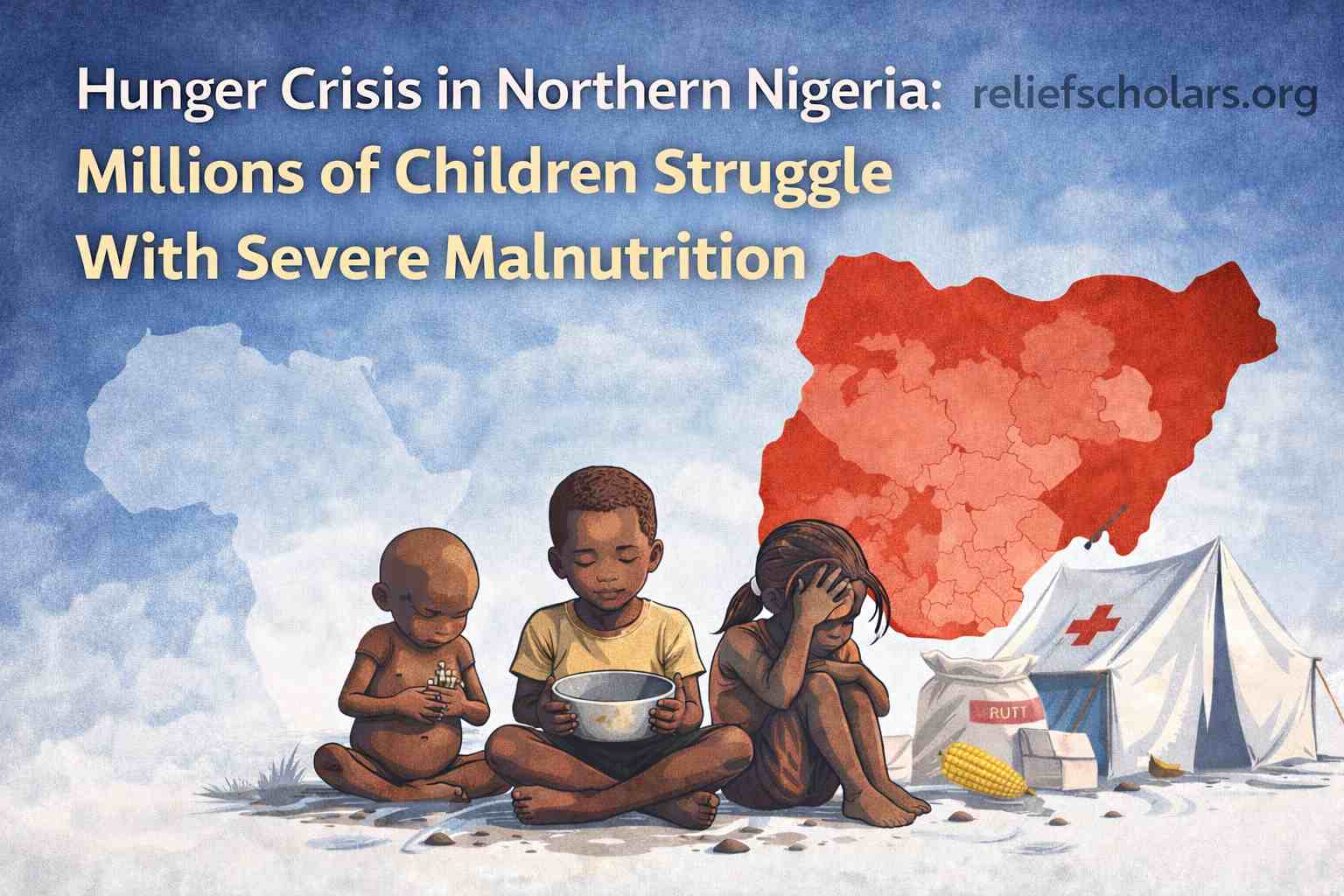
Nigeria is currently facing one of the most serious humanitarian crises affecting children in recent years. Millions of young children are suffering from severe hunger and malnutrition, especially in the northern parts of the country where armed conflict, displacement, and poverty have made it difficult for families to survive.
According to recent humanitarian reports, nearly 6.4 million children under the age of five across Nigeria’s northeast, northwest, and north-central regions are currently suffering from acute malnutrition. This means that millions of children are not getting the nutrients their bodies need to grow, fight disease, and survive.
For many families living in conflict-affected communities, daily life has become a struggle for survival. Parents are unable to farm their land, food prices are rising, and healthcare services remain limited in many areas.
This article explains the situation in simple terms and explores:
- Why malnutrition is increasing in northern Nigeria
- How conflict affects children and families
- Real stories from affected communities
- What humanitarian organizations are doing to help
- What needs to happen to reduce child malnutrition in Nigeria
The Hidden Crisis: Child Malnutrition in Northern Nigeria
Malnutrition occurs when the body does not receive enough essential nutrients such as proteins, vitamins, and minerals. When this happens to young children, the effects can be life-threatening.
In northern Nigeria, the problem has reached alarming levels.
Children suffering from acute malnutrition often experience:
- Severe weight loss
- Weak immune systems
- Delayed growth and development
- Increased risk of death from infections
For children under five, proper nutrition is extremely important because it is the most critical stage of physical and brain development.
Unfortunately, millions of Nigerian children are not receiving adequate food due to the combined effects of conflict, displacement, and poverty.
Read also: Neglected States in Nigeria 2026: Malnutrition Crisis and Urgent Needs After Assessment
How Conflict in Northeast Nigeria Worsened Food Insecurity
The armed conflict in northeast Nigeria has been ongoing for more than 15 years. During this period, millions of people have been displaced from their homes.
Communities in states such as:
- Borno
- Yobe
- Adamawa
have experienced repeated violence and insecurity.
When conflict occurs, families are often forced to flee their villages. As a result:
- Farmland is abandoned
- Crops are destroyed
- Livestock is lost
- Markets stop functioning
Without farmland or stable jobs, families lose their main source of food and income.
This situation directly leads to food shortages and malnutrition.
A Mother’s Story: Zainab and Her Son Umar
Behind the statistics are real families struggling to keep their children alive.
One of these mothers is Zainab, who brought her young son Umar to a nutritional stabilization center in Damaturu, Yobe State.
When she arrived at the clinic, Umar was only 22 months old, but his condition was extremely serious.
Zainab held him in her arms as he struggled to stay conscious. His face and feet were severely swollen, and his fragile body showed signs of extreme weakness.
She remembers the fear she felt at that moment.
“I thought I was going to lose him,” she said.
Since birth, Umar had struggled to eat properly. He was not gaining weight like other children and gradually became weaker over time.
Zainab did not know the medical name for the condition affecting her son, but health workers quickly recognized it.
Understanding Severe Acute Malnutrition
According to healthcare professionals at the stabilization centre, Umar was suffering from severe acute malnutrition, a condition that can quickly become fatal if not treated.
The swelling on his body was caused by nutritional edema, a dangerous form of malnutrition that occurs when the body lacks essential nutrients for a long period.
Symptoms of severe acute malnutrition may include:
- Swelling of the face and limbs
- Extreme thinness
- Weakness and fatigue
- Loss of appetite
- Increased vulnerability to infections
Without urgent medical care and proper nutrition, children suffering from this condition often do not survive.
Read also: Common Endemic Diseases in Nigeria 2026: Causes, Impact, Prevention & Public Health Response
Treatment That Saves Lives
Fortunately for Umar, he arrived at the stabilization centre in time to receive treatment.
Health workers provided him with:
- Therapeutic feeding
- Medical treatment
- Regular monitoring by trained nurses
Therapeutic foods used in these centres contain essential nutrients that help children recover quickly from severe malnutrition.
Within a week of treatment, Umar began to show signs of improvement.
The swelling gradually reduced, and he slowly regained his appetite.
Today, he is recovering.
His story shows that with the right treatment, even severely malnourished children can survive and regain their health.
Children and Mothers Are the Most Vulnerable
In conflict-affected areas, children and mothers face the highest risk of malnutrition.
The most vulnerable groups include:
- Children under five years old
- Pregnant women
- Breastfeeding mothers
These groups require more nutrients to maintain their health and support child development.
However, in areas where food is scarce, families often struggle to provide balanced meals.
As a result, children become the first victims of hunger.
Displacement Makes the Situation Worse
Another major factor contributing to malnutrition is displacement.
When people flee their homes due to conflict, they often lose everything they depend on for survival.
Fatima, a woman displaced from Sabon Gari in Borno State, experienced this reality firsthand.
After being forced to leave her home, she suddenly found herself responsible for 13 children with almost no food.
She described the difficult situation her family faced.
“When we were displaced, we lost our source of livelihood. We depended on neighbours and odd jobs just to eat.”
Without farmland or regular income, many displaced families struggle to survive.
For children living in such conditions, malnutrition becomes almost inevitable.
The Link Between Displacement and Hunger
The connection between displacement, poverty, and malnutrition is very clear.
When families lose their homes and livelihoods:
- Food production stops
- Household income disappears
- Access to markets becomes limited
- Health services become harder to reach
All of these factors contribute to food insecurity.
Children living in displaced communities often suffer the most because their nutritional needs are high but resources are extremely limited.
What Humanitarian Organizations Are Doing
Humanitarian organizations are working hard to address the malnutrition crisis in northern Nigeria.
One of the organizations involved in this effort is the International Committee of the Red Cross (ICRC).
Their approach focuses on both treatment and prevention.
Medical Treatment for Malnourished Children
Health centres supported by humanitarian organizations provide treatment for severely malnourished children.
These centres offer:
- Therapeutic feeding
- Medical care
- Monitoring by trained health professionals
Each year, thousands of children receive treatment through these facilities.
According to nutrition experts working in Borno State, treatment centres handle a large number of cases annually.
Some facilities treat more than 1,000 children every year.
When children recover enough to leave the clinic, they are often given ready-to-use therapeutic food (RUTF) to continue their recovery at home.
Why Medical Care Alone Is Not Enough
Treating malnutrition is important, but it does not solve the root causes of the problem.
If families return home to the same conditions that caused the malnutrition, the problem will simply repeat itself.
That is why humanitarian organizations are focusing on broader solutions such as:
- Livelihood support
- Agricultural assistance
- Access to clean water
- Hygiene education
These programs help families rebuild their lives and improve food security.
Supporting Farmers and Pastoral Communities
Many families in northern Nigeria depend on farming or livestock for survival.
When conflict disrupts these activities, food shortages quickly follow.
To help communities recover, humanitarian organizations provide support such as:
- Climate-smart seeds
- Agricultural tools
- Solar-powered irrigation systems
- Veterinary support for livestock
These initiatives allow families to grow food again and rebuild their income sources.
Cash Assistance for Vulnerable Families
Another important intervention is cash assistance.
During the 2025 lean season, thousands of vulnerable families received financial support to help them buy food and meet urgent needs.
More than 17,000 families benefited from this program.
Cash assistance helps stabilize household consumption during the most difficult periods of the year when food is scarce.
Community Nutrition Programs
In addition to hospital treatment, many communities now run nutrition monitoring programs.
These programs train community members to:
- Measure children’s upper arm circumference (MUAC)
- Identify early signs of malnutrition
- Refer children to treatment centres
Community-based nutrition programs allow health workers to identify cases early before they become life-threatening.
Hygiene and Water Support
Poor sanitation and unsafe drinking water can worsen malnutrition by increasing the risk of disease.
To address this issue, thousands of families have received hygiene kits and access to improved water sources.
In 2025 alone, more than 26,000 people received hygiene kits to help improve living conditions and prevent disease outbreaks.
The Scale of Humanitarian Support
The humanitarian response in northern Nigeria has reached hundreds of thousands of people.
In 2025:
- 348,000 people received treatment for severe acute malnutrition
- 16,000 children under five were treated in health facilities
- 19,000 pregnant and breastfeeding women received nutrition support
- 125 communities received nutrition interventions
These efforts have helped save many lives.
However, the needs remain extremely high.
Why the Crisis Is Still Growing
Despite ongoing humanitarian support, the malnutrition crisis continues to grow.
Several factors contribute to this situation:
Continuing Insecurity
Violence in some areas continues to prevent families from returning to their homes and farmland.
Rising Food Prices
Economic challenges and inflation have made food more expensive.
Climate Challenges
Floods, droughts, and unpredictable weather affect food production.
Funding Shortages
Humanitarian programs require significant financial resources, and funding gaps can limit the scale of assistance.
What Nigeria Needs to Address the Crisis
Solving the malnutrition crisis requires a coordinated effort involving government agencies, humanitarian organizations, and local communities.
Key priorities include:
- Expanding nutrition treatment services
- Improving access to healthcare in rural areas
- Supporting agricultural recovery
- Strengthening food security programs
- Protecting vulnerable communities from conflict
Addressing these issues will help ensure that fewer children suffer from malnutrition in the future.
A Message of Hope
Despite the difficult situation, stories like Umar’s provide hope.
With the right support, children suffering from malnutrition can recover and lead healthy lives.
For mothers like Zainab and Fatima, access to food, healthcare, and livelihood support has made a real difference.
Seeds, medical care, and the possibility of a good harvest offer families a chance to rebuild their lives.
Conclusion
The malnutrition crisis affecting millions of Nigerian children is one of the most urgent humanitarian challenges facing the country today.
Conflict, displacement, poverty, and food insecurity have created conditions where children struggle to access the nutrition they need to survive.
However, with continued humanitarian support, stronger government action, and sustainable development programs, it is possible to reduce malnutrition and protect vulnerable communities.
For families in northern Nigeria, hope lies in access to healthcare, improved food production, and the resilience of communities determined to rebuild their future.

1 Comment.
Comments are closed.