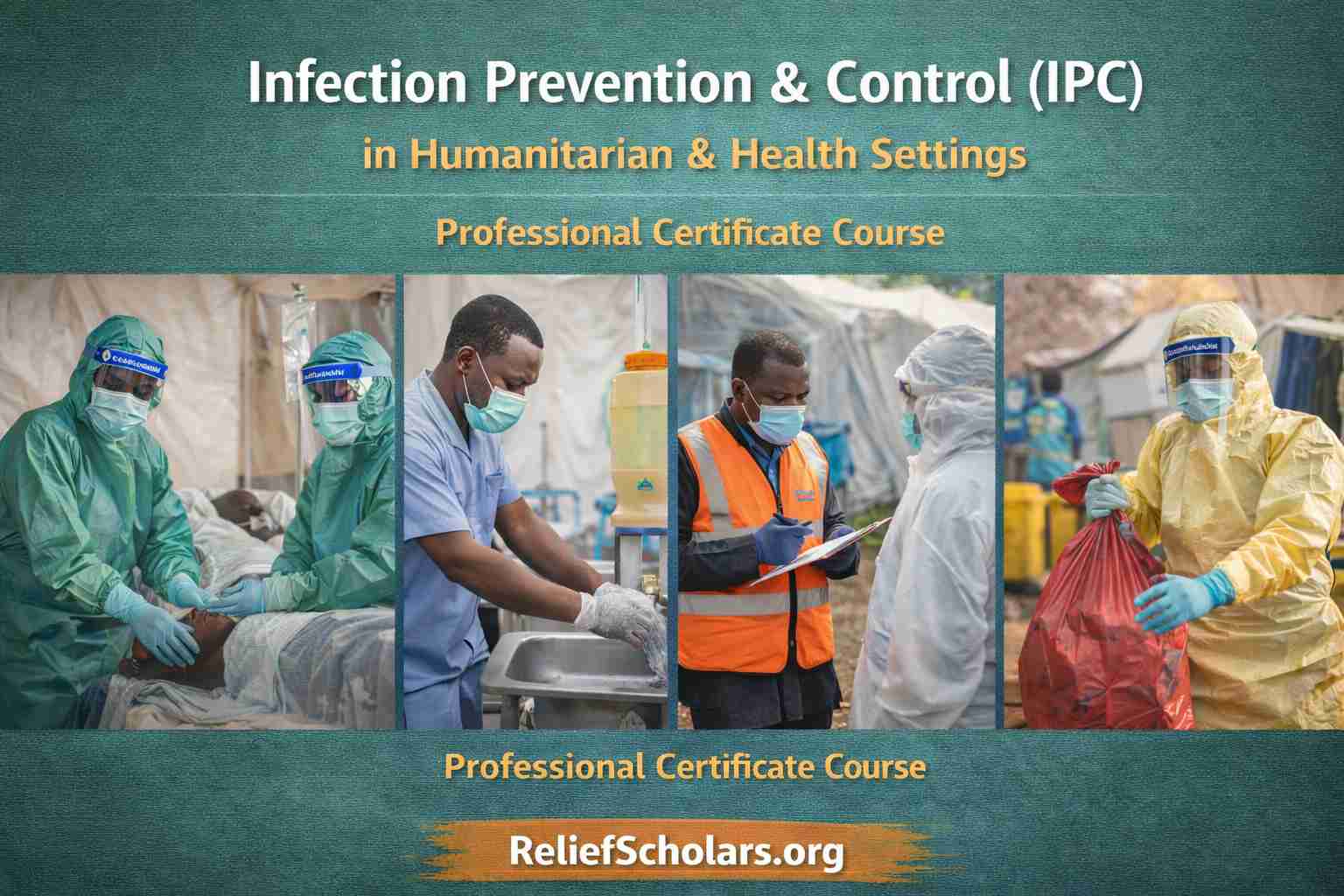
Infection Prevention & Control (IPC) in Humanitarian & Health Settings
About Course
The Infection Prevention & Control (IPC) course provides comprehensive knowledge and practical skills to prevent and control the spread of infections in healthcare and humanitarian settings.
In emergency contexts—such as disease outbreaks, displacement camps, and low-resource health facilities—strong IPC systems are essential to protect patients, healthcare workers, and communities.
This course covers core IPC principles, standard precautions, transmission-based precautions, hand hygiene, personal protective equipment (PPE), environmental cleaning, waste management, outbreak response, and monitoring systems.
Learners will gain practical tools to strengthen infection control practices in clinics, hospitals, community settings, and emergency operations.
Upon successful completion, participants will receive a Professional Certificate of Completion from ReliefScholars.
What Will You Learn?
- Explain core principles of infection prevention and control
- Identify common modes of infection transmission
- Apply standard precautions in healthcare settings
- Use Personal Protective Equipment (PPE) correctly
- Implement hand hygiene and environmental cleaning protocols
- Manage healthcare waste safely
- Apply IPC measures during outbreaks
- Integrate IPC into humanitarian response programming
- Monitor and improve IPC compliance in facilities
Course Content
Module 1: Foundations of Infection Prevention & Control
Introduces core IPC principles and importance in health and humanitarian settings.
-
What is Infection Prevention & Control?
-
Why IPC Matters in Emergencies
-
Chain of Infection

Module 2: Modes of Transmission
Explains how infections spread.
-
Contact Transmission
-
Droplet and Airborne Transmission
-
Environmental and Fomite Transmission
-
Breaking the Chain of Infection
Module 3: Standard Precautions
Core safety practices for all patient care.
-
Hand Hygiene Principles
-
Respiratory Hygiene
-
Safe Injection Practices
-
Handling Blood and Body Fluids
Module 4: Personal Protective Equipment (PPE)
Operational application of protective measures.
-
Types of PPE
-
Proper Donning and Doffing
-
PPE in Low-Resource Settings
-
Common PPE Mistakes
Module 5: Environmental Cleaning & Disinfection
Focuses on facility-level infection control.
-
Cleaning vs Disinfection
-
Surface Decontamination
-
Chlorine Preparation
-
Safe Cleaning Protocols
Module 6: Healthcare Waste Management
Safe disposal and risk reduction.
-
Waste Segregation
-
Sharps Management
-
Waste Disposal Methods
-
Community Safety
Module 7: IPC in Outbreak Response
Links IPC to cholera, COVID-19, Ebola, and other outbreaks.
-
Isolation and Cohorting
-
IPC in Cholera Treatment Centers
-
Outbreak Preparedness
-
Rapid IPC Assessment
Module 8: Monitoring & Improving IPC Systems
Focuses on compliance and quality improvement.
-
IPC Checklists
-
Supervision and Monitoring
-
Incident Reporting
-
Training and Staff Engagement
Module 9: Practical Case Studies & Field Application
Applies learning in realistic scenarios.
-
IDP Camp Health Facility Scenario
-
Cholera Outbreak Case Study
-
Hospital IPC Audit Example
-
Course Review & Assessment Preparation
Final Quiz Assessment
Infection Prevention & Control (IPC) in Humanitarian & Health Settings
-
Infection Prevention & Control (IPC) in Humanitarian & Health Settings